
Why Is Delina Perfume So Expensive? The Honest Answer
Posted by Jeff Nelson on Jun 25th 2026
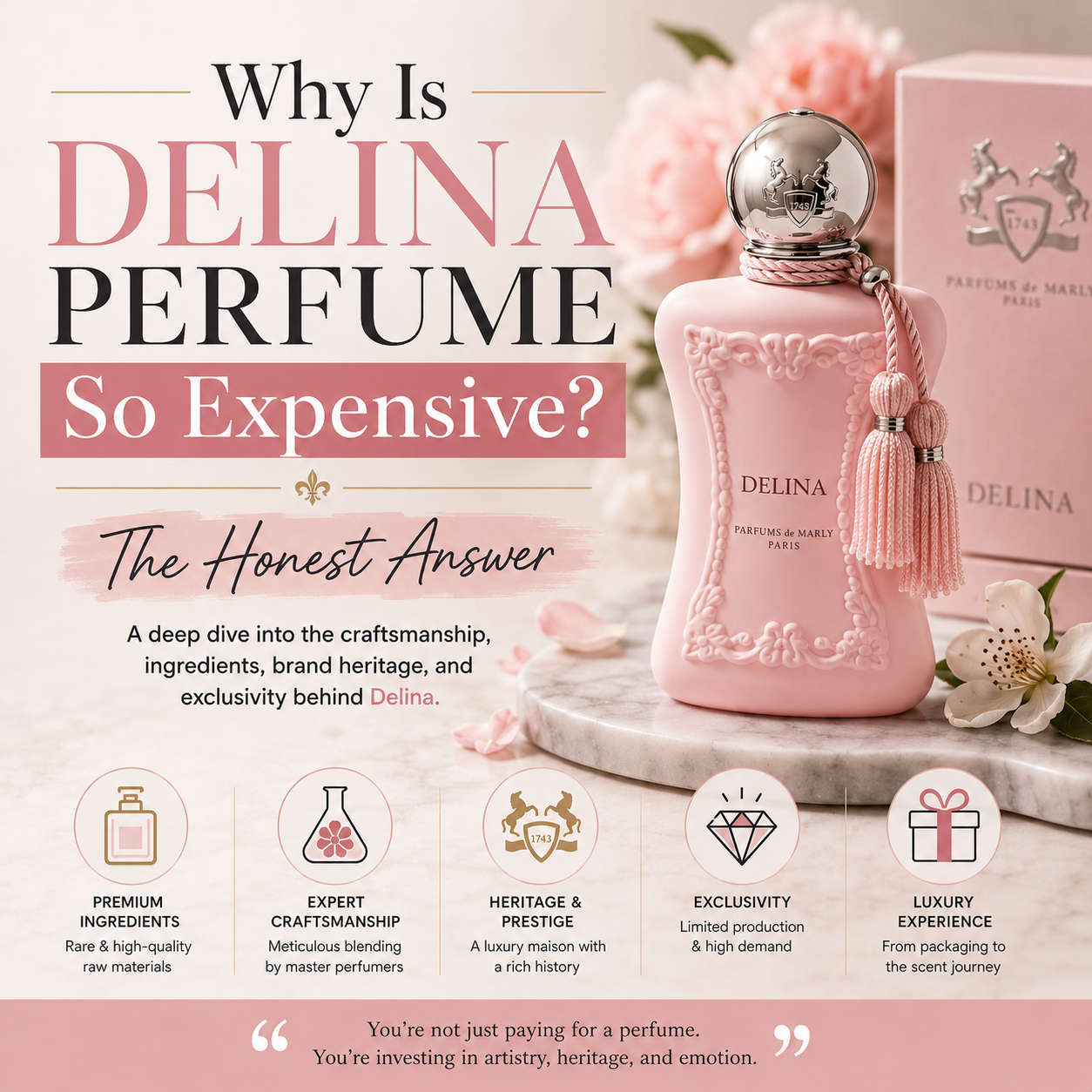
Delina by Parfums de Marly is expensive because of a single patented ingredient that competitors cannot legally replicate — a captive molecule called Petalia, developed by the Swiss fragrance house Givaudan, that gives Delina its distinctive vibrating, almost luminous rose quality. That molecule, the Turkish Damascena rose it supports, the niche house production model behind the bottle, and a deliberate distribution strategy that keeps Delina out of mass-market channels all compound into a price between $250 and $375 for a 75ml bottle. Here is exactly what you are paying for.
What is Delina perfume?
Delina is an Eau de Parfum by Parfums de Marly, a French niche fragrance house founded in 2001 by Julien Sprecher and inspired by the opulent court of King Louis XV — known historically as "La Cour Parfumée" for its obsession with fragrance and luxury. Delina was created by master perfumer Quentin Bisch in 2017 and built around a single ambition: a rose fragrance that felt edible, vibrant, and modern rather than heavy or old-fashioned. It became the house's defining fragrance and one of the most TikTok-viral perfumes of the 2020s.
Why Is Delina Perfume So Expensive? The Key Factors at a Glance
| Factor | What It Means | Cost Impact |
|---|---|---|
| Petalia molecule | Patented Givaudan ingredient — cannot be replicated in dupes | High — licensed at premium per unit |
| Turkish Damascena rose | One of the most expensive natural materials in perfumery | Very high — rose otto costs more than gold by weight |
| Niche house model | Low volume, high ingredient cost, deliberate exclusivity | High — no mass-market scale savings |
| Bottle and packaging | French-manufactured faceted glass, weighted cap, luxury finishing | Moderate to high — significantly more than designer bottles |
| Limited distribution | Not sold in drugstores or discount outlets | High — maintains price integrity, limits volume discounts |
| TikTok demand effect | Viral popularity allows pricing to hold despite awareness growth | Moderate — demand allows premium to be maintained |
Why Is Delina Perfume So Expensive? The Petalia Molecule Explained
This is the real answer — and the one most "why is Delina so expensive" articles miss entirely.
At the center of Delina's rose accord sits a captive molecule called Petalia, developed by Givaudan — one of the world's largest fragrance ingredient suppliers. A captive molecule is a proprietary fragrance material that is licensed exclusively to specific perfumers or houses, meaning competitors cannot access it to replicate the same olfactory effect. Quentin Bisch used Petalia to create what he describes as a rose that feels "crunchy, edible, and neon bright" — the distinctive quality that makes Delina's rose smell unlike every other rose fragrance on the market.
This is why the dupe market consistently fails to replicate Delina convincingly. Dupes can approximate the notes — lychee, rhubarb, rose, cashmeran — but they cannot access Petalia. Without that specific molecule, the particular vibrancy and diffusive quality of Delina's rose heart simply does not exist in the replica. The fragrance you smell from a dupe is structurally different from the original because a core component of what makes the original what it is is legally unavailable to anyone else.
The cost of licensed captive molecules is factored into the per-bottle production cost and contributes meaningfully to why niche fragrances using proprietary materials price significantly above designer alternatives.
Why Is Delina Perfume So Expensive? The Turkish Rose Factor
Alongside the Petalia molecule, Delina is built around Turkish Damascena rose — one of the most expensive natural raw materials used in commercial perfumery. The Damascena rose, grown primarily in the Rose Valley of Bulgaria and the Isparta region of Turkey, yields its essential oil only once per year during a brief spring harvesting window of a few weeks. Each kilogram of rose otto requires several thousand kilograms of hand-harvested petals, processed at dawn before the heat of the day causes the volatile aromatic compounds to evaporate.
The result is an ingredient that costs several thousand dollars per kilogram — more expensive than gold by weight in concentrated form. Parfums de Marly's formulations are not built to minimize ingredient costs the way mass-market designer fragrances are. The rose in Delina is present at a concentration that delivers the performance reviewers praise — the luminous, fresh, slightly dewy quality of the heart — and that concentration has a price that flows directly into the bottle.
This is the clearest way to understand the price gap between Delina and a designer fragrance at a fraction of the cost. The designer fragrance uses primarily synthetic rose approximations. Delina uses the genuine article at meaningful concentration.
Why Is Delina Perfume So Expensive? The Niche House Pricing Model
Parfums de Marly operates on a fundamentally different business model than Chanel, Dior, or Armani — and that model drives a different price point regardless of ingredient costs.
A niche house produces lower volumes, invests a higher proportion of its cost structure into ingredients rather than advertising, and deliberately limits its distribution to maintain the exclusivity perception that sustains premium pricing. Parfums de Marly does not sell through Walmart, does not license to third-party mass-market retailers, and does not run volume-discount campaigns. This means the per-bottle economics never benefit from the scale savings that designer houses generate through mass distribution.
The house's identity is also embedded in its pricing. Parfums de Marly was conceived as a tribute to Louis XV's court — a world defined by excess, craftsmanship, and the absence of compromise on quality. Positioning the brand below a certain price threshold would contradict the identity it was built on. The price is partly the ingredient story and partly the story the bottle is telling before you even open it.
For more on how niche houses compare to designer fragrance houses and what the difference means for your buying decisions, see our guide to finding your perfect perfume brand.
Why Is Delina Perfume So Expensive? The Bottle and Packaging
The faceted pink bottle is not just a container — it is a deliberate luxury object manufactured in France using high-quality glass and a weighted metal cap that creates the kind of heft and solidity associated with serious fragrance. The production cost of this bottle significantly exceeds what designer fragrance houses spend on their packaging, and that cost is not hidden from the final retail price.
Each bottle is inspected individually before leaving the facility. The packaging uses textured paper, foil finishing, and soft-touch surfaces — the kind of tactile experience that signals the price before the fragrance reaches your wrist. None of this is incidental. It is part of what a niche house sells alongside the fragrance itself — the experience of owning something made with genuine attention to detail at every stage.
Is Delina Perfume Worth the Expensive Price Tag?
This is the most honest part of the answer.
If you love rose fragrances and want something genuinely distinctive that cannot be replicated — Petalia ensures that — then yes, the investment is defensible. The longevity is exceptional: most wearers report 8 to 10 hours of consistent performance, which means cost-per-wear over a full bottle is lower than it initially appears. The compliment factor is real and consistent — Delina is among the most frequently cited fragrance choices when people describe being asked what they are wearing.
If you are buying primarily because of TikTok association or the bottle's visual impact, the fragrance itself may not live up to the expectation — Delina is a rose fragrance, and if rose is not a note you naturally gravitate toward, the price becomes genuinely difficult to justify.
The honest caveat: skin chemistry affects Delina significantly. On some skin types the rhubarb and lychee opening reads as vibrant and distinctive. On others, particularly in humid environments, the fragrance can fade faster than the price tag suggests it should. Testing on your own skin before purchasing a full bottle is strongly recommended.
Shop Parfums de Marly Delina at HottPerfume — available below the standard retail price, authentic, in box.
What Does Delina Perfume Actually Smell Like?
Understanding why it is expensive requires understanding what you are getting for the money.
Top notes: Lychee, rhubarb, bergamot, nutmeg
The opening is vivid and immediately distinctive — rhubarb provides a tart, almost crisp brightness that cuts through the sweetness of lychee in a way that reads as genuinely sophisticated rather than candy-adjacent. Bergamot and nutmeg add warmth and spice beneath the fruit. The opening is brief but impactful — most wearers describe the first spray as the moment they understood what the conversation around this fragrance is about.
Heart notes: Turkish Damascena rose, peony, lily of the valley, jasmine
The rose heart is where Petalia creates the experience that makes Delina what it is. This is not a heavy, powdery, old-fashioned rose. It is a dewy, vibrant, almost edible rose — the specific quality that reads as "expensive rose" rather than "generic floral." Peony and lily of the valley support without competing, and jasmine adds depth without tipping the heart toward any of the heavier, more animalic territory jasmine can occupy.
Base notes: Vanilla, cashmeran, musk, vetiver
The dry down is soft and warm — cashmeran (a synthetic material with a warm, woody, slightly musky character) gives the base its distinctive skin-close quality. Vanilla and musk extend the fragrance without sweetening it excessively, and vetiver adds a subtle earthy groundedness that keeps the base from reading as purely gaurmand. The base is what accounts for the longevity and the trail — the part of Delina most responsible for the compliments.
How Does Delina Compare to Its Flankers?
Parfums de Marly has extended the Delina line with two flankers that offer different interpretations of the same rose DNA:
| Version | Character | Best For |
|---|---|---|
| Delina (Original) | Bright, fresh, vibrant rose — the daytime icon | Spring, summer, daytime, compliment-seeking |
| Delina La Rosée | Lighter and more translucent — morning grace | Minimalist rose lovers, warmer weather |
| Delina Exclusif | Richer, deeper, oud and vanilla — evening bloom | Evening occasions, cooler months, more intensity |
The original remains the most worn and most recognized version. La Rosée is for those who find the original slightly too bold. Exclusif is for those who want more.
Why Authenticity Matters When Buying Delina Perfume
At HottPerfume, Delina is 100% authentic — sourced through verified distributors and stored in temperature-controlled conditions. The fragrance you receive performs exactly as described. At below-retail pricing, it significantly improves the value proposition that this expensive fragrance presents.
? Parfums de Marly Delina EDP — the Petalia rose. TikTok-viral. Genuinely irreplaceable.
Shop Delina at HottPerfume — below retail, authentic, in box.
For more women's fragrances across every price tier, see our full women's perfume collection.
Frequently Asked Questions: Why Is Delina Perfume So Expensive?
What makes Delina perfume different from cheaper rose fragrances?
The primary difference is a patented molecule called Petalia — a proprietary Givaudan ingredient used by perfumer Quentin Bisch to create Delina's distinctive "vibrating rose" quality. This molecule is licensed exclusively and cannot be accessed by producers of cheaper alternatives or dupes. The combination of Petalia and genuine Turkish Damascena rose creates a rose accord that genuinely has no equivalent at any lower price point. For more on how fragrance pricing relates to ingredients and brand positioning, see our guide to choosing a signature perfume.
Why do Delina dupes smell different from the original?
Because the core molecule responsible for Delina's distinctive rose character — Petalia — is a patented captive ingredient unavailable to copycat producers. Dupes can replicate the surrounding notes (lychee, rhubarb, vanilla, musk) but cannot access Petalia. The result is a rose fragrance that approximates the category but lacks the specific vibrancy and diffusive quality that makes Delina instantly recognizable. This is not a matter of effort or investment on the dupe producer's part — the ingredient is simply legally unavailable to them.
Where can you buy Delina perfume below retail price?
HottPerfume carries Parfums de Marly Delina at below-retail pricing — authentic, in box, sourced through verified distributors. This makes the value proposition for one of the fragrance market's more expensive bottles significantly more defensible, particularly given that at below-retail pricing the cost-per-wear over the life of a bottle becomes quite reasonable for a fragrance with genuine 8 to 10 hour longevity. Delina also appears among HottPerfume's current top-rated trending fragrances — confirming its continued relevance and demand.