
How to Choose a Signature Perfume: The Complete Decision Guide
Posted by Jeff Nelson on May 31st 2026
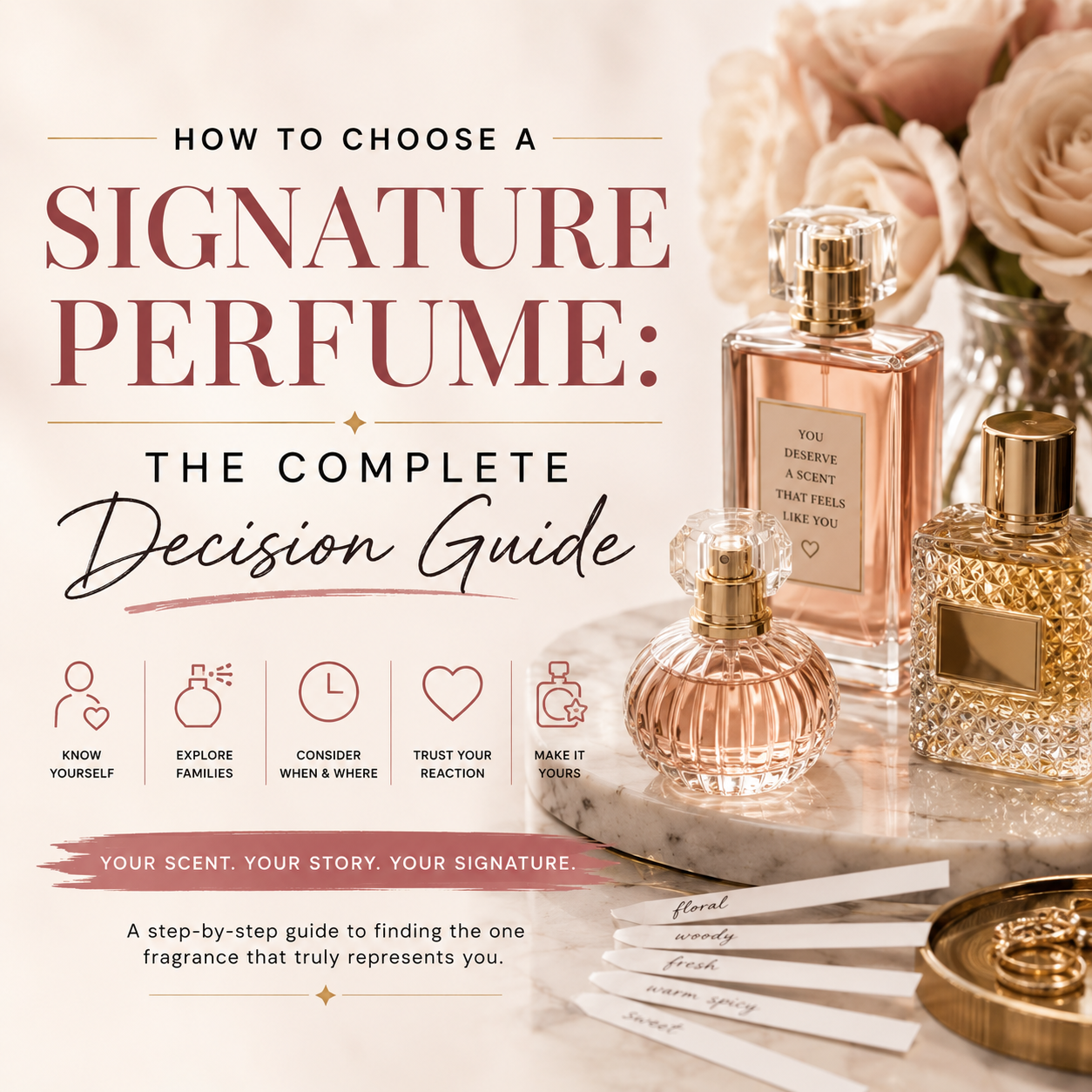
Choosing a signature perfume means finding one fragrance that consistently represents you — a scent so aligned with your personality, lifestyle, and skin chemistry that people associate it with you before you say a word. It is not the same as finding a fragrance you like. It is finding the one you reach for without thinking, wear without hesitation, and feel incomplete without. This guide walks you through every decision you need to make to find it.
What is a signature perfume? A signature perfume is a single fragrance worn consistently enough that it becomes an olfactory identity — the scent others associate with your presence. It should work across your primary occasions, complement your skin chemistry, and reflect your personal style with enough longevity and projection to leave the impression you intend.
How to Choose a Signature Perfume: The Decision Framework at a Glance
| Step | Decision | What It Determines |
|---|---|---|
| 1. Personality | What image do I want to project? | Overall scent character — bold, soft, clean, complex |
| 2. Fragrance family | Which scent category feels like me? | Floral, woody, oriental, fresh, gourmand, chypre |
| 3. Occasion | When will I wear this most? | Day vs evening, office vs casual, all-season vs specific |
| 4. Season | What climate do I live in? | Light vs heavy, citrus vs resinous, warm vs cool |
| 5. Concentration | How long do I need it to last? | EDT, EDP, or Parfum |
| 6. Skin chemistry | How does it actually smell on me? | The final and most important variable |
| 7. Budget | What is my cost-per-wear threshold? | Designer vs niche, bottle size, subscription |
Work through this in order. Most people start at step six and wonder why they keep buying fragrances they stop wearing.
How Do I Know What Kind of Signature Perfume Suits My Personality?
Your fragrance should project the same impression you want to make in person. The two are not separate decisions — how you want to be remembered and what you wear are the same conversation.
Bold and seductive: Oriental and gourmand fragrances — dark florals, warm spices, vanilla, cocoa, and amber. Fragrances like Carolina Herrera Good Girl or YSL Black Opium live in this space. They project confidently and linger. Best for evening occasions and cooler months.
Clean and sophisticated: Fresh and woody fragrances — citrus, lavender, cedar, vetiver, and white musk. Fragrances like Burberry Touch for Men or Armani Code Cologne sit here. They work in professional environments and across seasons without demanding attention.
Feminine and romantic: Floral fragrances — rose, jasmine, peony, tuberose, and iris. Lancôme La Vie Est Belle leads this category. They wear beautifully from daytime through evening and suit almost any occasion.
Distinctive and memorable: Chypre and leather fragrances — oakmoss, bergamot, patchouli, and animalic notes. These are the fragrances with the most personality and the most devoted wearers. Not universally accessible but deeply individual.
Effortless and understated: Aromatic and aquatic fragrances — clean musks, marine notes, and light woods. These are the day-to-day workhorses — never wrong, never overwhelming, reliably present.
How Do Fragrance Families Help You Choose a Signature Perfume?
The fragrance wheel organizes all perfumes into families based on their dominant character. Understanding which family consistently appeals to you eliminates most of the confusion in the selection process.
Floral: Built around flower notes — rose, jasmine, peony, iris, tuberose, lily. The most popular feminine fragrance family. Ranges from light and powdery to rich and heady. For women who want something unmistakably feminine and timeless. Browse floral perfumes for women at HottPerfume.
Oriental/Amber: Built around warm, resinous, and spiced materials — vanilla, amber, tonka bean, oud, benzoin, and incense. Bold, long-lasting, and seductive. The family of choice for evening wear and cold-weather signature scents.
Woody: Built around cedarwood, sandalwood, vetiver, guaiac wood, and patchouli. Works across genders, seasons, and occasions. The most versatile family and the backbone of most men's designer fragrances. Browse men's colognes at HottPerfume.
Fresh: Built around citrus, green notes, marine accords, and light musks. Clean, energetic, and universally appropriate. The family that suits daytime and professional wear most naturally but rarely functions as a standalone signature — too linear and too light to leave the kind of impression a signature scent requires.
Gourmand: Built around edible notes — chocolate, coffee, caramel, praline, and vanilla. Warm, sweet, and deeply modern. The fastest-growing family in the designer fragrance market and the dominant character behind fragrances like Good Girl and Black Opium.
Chypre: Built around oakmoss, bergamot, and labdanum. Complex, sophisticated, and polarizing. The family with the most devoted wearers and the least forgiving learning curve — when it works, nothing else compares.
For a deeper breakdown of scent families and what they smell like in practice, see our guide to essential types of perfume scents.
How Does Occasion Affect Choosing a Signature Perfume?
A genuine signature perfume works across your primary occasions without you having to think about it. The mistake most buyers make is choosing a fragrance that excels in one context and wears poorly in another — then wondering why they stop reaching for it.
Office and professional wear demands soft projection, clean character, and no sweetness or heaviness that would intrude in close-quarter settings. Woody and fresh fragrances work here. Heavy orientals and most gourmands do not.
Evening and social occasions reward bold projection, rich complexity, and longevity. Oriental, gourmand, and dark floral fragrances perform best when the context gives them room to work. A fragrance that feels too much in an office becomes exactly right at dinner.
All-occasion signatures — the true goal — require a fragrance with enough character to feel intentional but enough restraint to work anywhere. This is genuinely difficult to find, which is why most experienced fragrance wearers maintain a small rotation rather than a single bottle.
How Does Season Affect Choosing a Signature Perfume?
Fragrance chemistry responds to temperature and humidity. This is not preference — it is chemistry.
Warm weather amplifies everything. Heavy orientals, thick gourmands, and high-sillage florals can become overwhelming in summer heat. Light citrus, clean musks, and airy florals perform best when the temperature rises.
Cold weather demands more. Fresh citrus fragrances evaporate quickly in cold air and lose their character before they've had a chance to develop. Woody, spiced, and oriental fragrances deepen and bloom in cool weather — which is why fragrances like Burberry London or Armani Code Profumo are devoted cold-weather signatures for their wearers.
The true all-season signature sits in the middle — a woody floral or soft oriental with enough brightness for spring and enough warmth for fall. These are the rarest and most valuable finds in the designer fragrance market.
How Does Concentration Affect Choosing a Signature Perfume?
The concentration of fragrance oil in a bottle determines how long it lasts and how strongly it projects. For a signature perfume — one you wear daily and rely on to represent you — this decision matters more than most buyers realize.
| Concentration | Oil % | Longevity | Projection | Best Use |
|---|---|---|---|---|
| Eau de Cologne (EDC) | 2–4% | 2–3 hours | Soft | Summer, gym, casual |
| Eau de Toilette (EDT) | 5–15% | 3–5 hours | Moderate | Everyday, office, warm weather |
| Eau de Parfum (EDP) | 15–20% | 6–8 hours | Moderate to strong | Everyday, evening, all seasons |
| Parfum / Extrait | 20–30%+ | 8–12 hours | Skin-close but lasting | Special occasions, dry skin |
For a daily signature, Eau de Parfum is the most practical choice for most wearers — long enough to not require reapplication, present enough to serve its purpose without requiring heavy-handedness in application. For a complete breakdown of concentration differences and what they mean in practice, see our fragrance type guide.
How Does Skin Chemistry Affect Your Signature Perfume Choice?
Skin chemistry is the final and most important variable in selecting a signature perfume — and the one most buyers skip. Every fragrance smells different on different skin, and no amount of description, review reading, or smelling from a bottle will tell you how a fragrance actually performs on yours.
Skin pH affects how top notes develop and how quickly they fade. Acidic skin tends to amplify citrus and sharp notes while burning through them faster. Alkaline skin tends to extend base notes and add warmth.
Body heat affects projection. Warmer skin generates stronger sillage from the same fragrance — which is why some wearers need fewer sprays than others with identical bottles.
Skin moisture affects longevity. Dry skin absorbs fragrance quickly and reduces staying power. Applying an unscented moisturizer before spraying extends the wear time of any fragrance significantly — particularly for base-note-heavy oriental and gourmand fragrances.
The practical rule: always wear a fragrance on your skin for at least four to six hours before committing to a full bottle. The top notes you smell in the first ten minutes are not the fragrance you will be wearing by the end of the day. The base notes are your signature — make sure you love where it ends, not just where it starts.
How Does HottPerfume Help You Find Your Signature Perfume?
Finding your signature perfume requires testing — and testing requires access to a range of authentic fragrances at a price that makes exploration practical. HottPerfume sources every fragrance through verified distributors, stores in temperature-controlled conditions, and sells at prices significantly below department store retail. This means the fragrance you test is performing exactly as it was formulated to perform — not degraded by improper storage or compromised by counterfeit sourcing.
A counterfeit or poorly stored bottle cannot tell you whether a fragrance works on your skin. An authentic bottle at below-retail pricing can.
Our Signature Perfume Recommendations by Profile
The bold, seductive signature: Carolina Herrera Good Girl — jasmine, cocoa, tonka bean. 8+ hours, strong projection, fall and evening.
The clean, sophisticated signature: Armani Code Cologne EDT — citrus, lavandin, guaiac wood. Versatile, year-round, office to evening.
The feminine, timeless signature: Lancôme La Vie Est Belle EDP — iris, praline, vanilla. Floral-gourmand, universally appealing, day to evening.
The seasonal winter signature: Burberry London for Men EDT — cinnamon, leather, port wine. Exclusively fall and winter, intensely distinctive.
? Ready to find yours? Browse the full fragrance collection at HottPerfume — every bottle authentic, all below retail. No minimum order. Free shipping available.
Frequently Asked Questions About How to Choose a Signature Perfume
How do I know if a perfume is right for me as a signature scent? A signature perfume earns its status when you reach for it without thinking — not because it smells best on the blotter or in the bottle, but because it smells right on your skin across different occasions and temperatures. Test any candidate on skin for a full day across at least two different weather conditions before committing. If you still want to wear it after the base notes have fully dried down — after six or more hours — it is worth considering as a signature.
How many sprays should a signature perfume take? A well-chosen signature perfume should require no more than two to four sprays on pulse points for appropriate daily wear. If you need significantly more than that to feel present, either the concentration is too light for your purposes or the fragrance is not projecting as intended on your skin chemistry. Both are useful signals — the first points toward a higher concentration, the second toward a different fragrance.
Should a signature perfume be worn year-round? The most practical signatures work across at least three seasons — spring, fall, and winter, with summer as the variable. Fragrances heavy in oriental, resinous, or gourmand materials often need to be set aside in summer heat. If year-round wear is important, prioritize woody or soft floral fragrances with moderate projection — they handle temperature variation most gracefully. For more guidance on building a fragrance rotation around a signature, see our guide to finding your perfect perfume brand.